
Post-Tensioning for Buildings
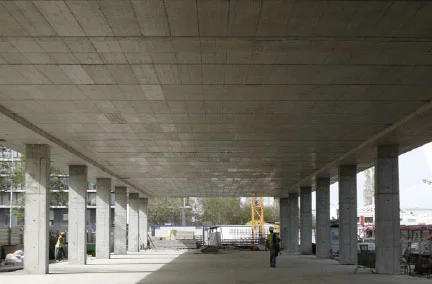
Prestress is an intelligent solution that leads to higher quality and more economical structures for spans greater than 8 metres.
Principles
The post-tensioning prestress system was originally developed to address the spans found in civil engineering structures, but its application and underlying principles have been gradually integrated into building construction. By definition, prestress is a technique that consists of introducing a prior state of stress into a structure in order to improve its resistance or behaviour, resulting in structures of higher quality and durability.
The use of prestress allows the construction of longer spans with slimmer and more economical slabs, fulfilling the aspirations of architects, developers and engineers.
An Active System
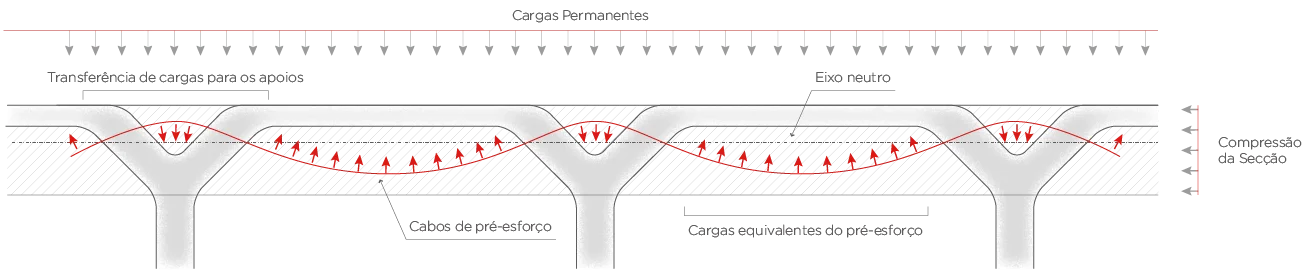
Composed of high-strength steel strands, the prestressing tendons are installed inside the slab and anchored at the ends, then tensioned using hydraulic equipment developed for this purpose. Thanks to their curvature in elevation and plan, the application of forces in the tendons allows actions contrary to the effects of gravity loads to be transmitted to the slab cross-section.
The equivalent loads thus created ensure partial balance of the design actions and generate a generalised compression in the slab cross-section, allowing the reduction of passive reinforcement, the elimination of joints, and a greater contribution of the concrete section to the overall resistance of the slab.
Characteristics
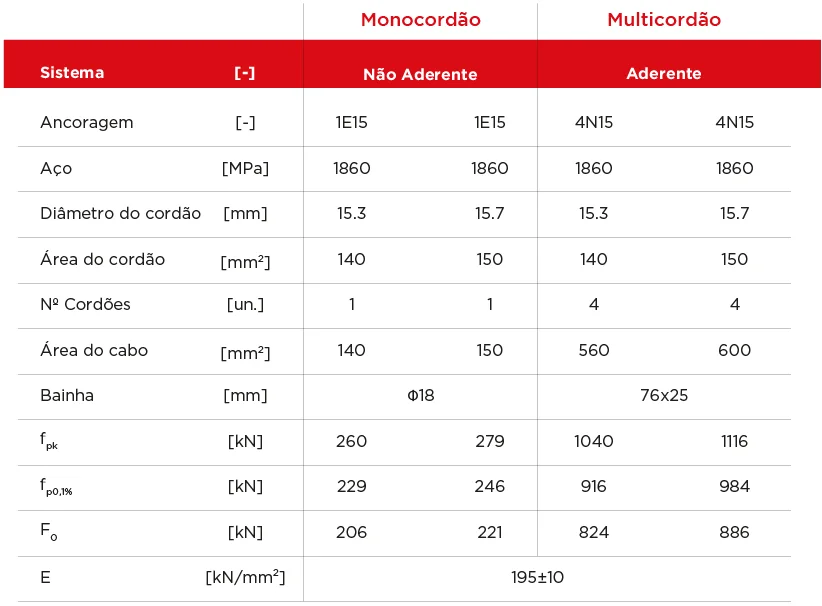
The prestress systems indicated for use in slender elements such as slabs in building construction are the unbonded monostrand and the multistrand in flat duct, the main distinction being the degree of bond to the concrete section.
The unbonded monostrand is an unbonded system where the prestressing tendons consist of a single strand coated with a polyethylene sheath filled with a lubricating product. This system allows greater eccentricities, lower friction losses and greater flexibility in tendon profiles.
The multistrand in flat or circular duct is a bonded system where the prestressing tendons consist of multiple uncoated strands inserted into a metal duct subsequently injected with cement grout. This system allows the full strength of the prestressing steel to be mobilised at the Ultimate Limit State.
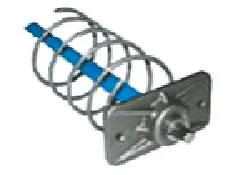
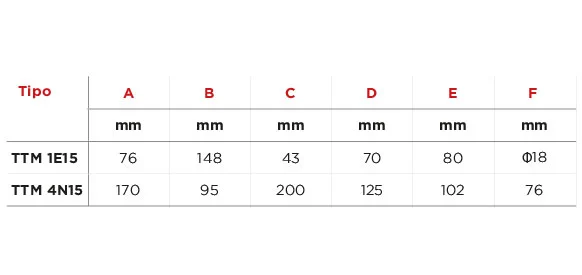
Anchor TTM 1E15
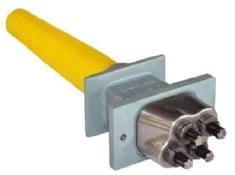
Anchor TTM 4N15
Note: For more information please visit our website www.ferca.pt
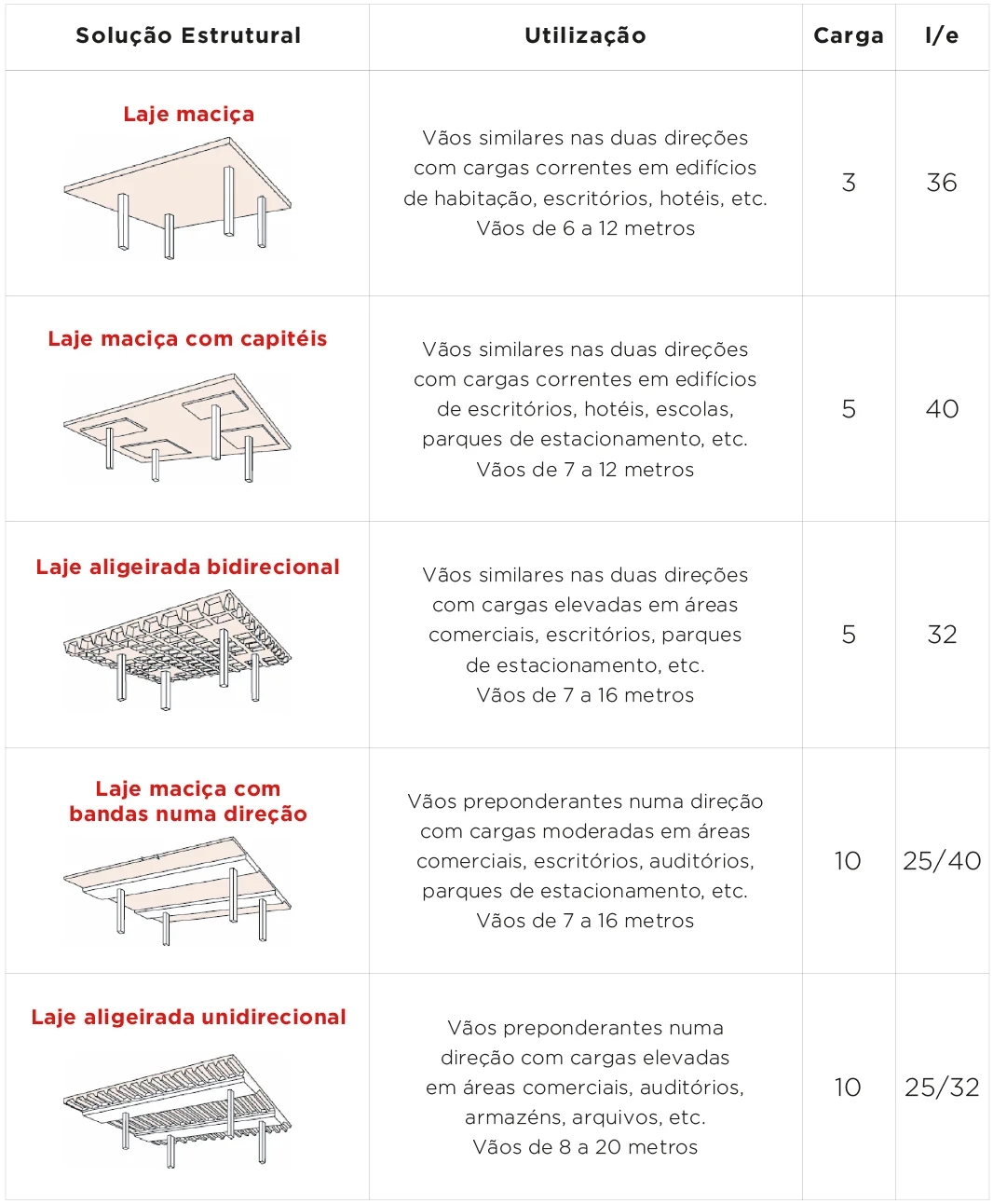
Note: The relationships shown are indicative only. For more information please contact us.

Design
Drawing on 40 years of experience applying prestress systems in buildings, Ferca has the resources, specialist software and technical staff needed to provide full support to designers during the conception, calculation and detailing phases of post-tensioned slabs.
Advantages
Behaviour
- Increased clear spans
- Reduction in number of columns
- Reduction in structural self-weight
- Reduced slab thicknesses
- Greater control of deformation
- Elimination of cracking
- Improved punching shear resistance
- Reduction or elimination of joints
- Improved seismic behaviour
- Improved shrinkage behaviour
Economy
- Reduction in concrete and steel consumption
- Savings in vertical elements and foundations
- Commercial value of the large open spaces created
- Increased number of car parking spaces per m²
- Reduction in post-sale costs
Sustainability
- Reduction of CO₂ emissions
- Greater efficiency in the use of natural resources
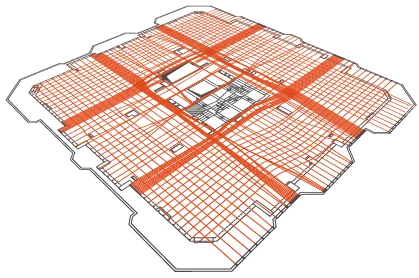
Ferca PTM — An Integrated System
The introduction of prestress in buildings today represents an increase in demand and quality in the construction process. Alongside the certification required for the materials and equipment that make up a prestress system, the execution method plays an important role given the speed and quality control required.
The System
Prestressing steel consists of 7-wire strands characterised by high strength values and low relaxation coefficients. In general, prestressing steels are classified as normal, super and compact, corresponding to cross-sections of 140, 150 and 165 mm² respectively. For more information consult the European standard EN10138.
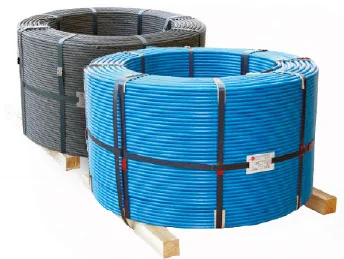
Note: The values shown are derived from EN10138, Eurocode EC2 and supplier documentation.
Anchors are responsible for absorbing the applied forces and transmitting them to the concrete section, making them the key element of the prestress system. Their production is subject to rigorous certification by EOTA — European Organisation for Technical Approvals. The TTM system is certified under ETA 15/0321, ETA 15/0329 and ETA 16/0472.
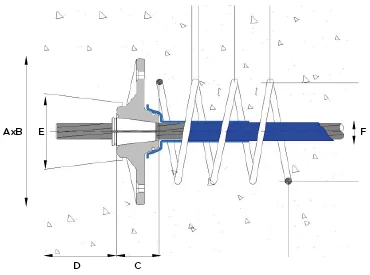
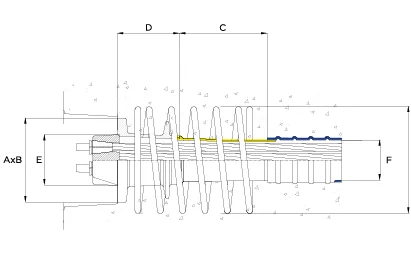
Ducts in bonded systems ensure the continuity of forces between their interior and the concrete section throughout their full length; they consist of corrugated metal sheets in circular or flat form. In the unbonded system the sheath is polyethylene, applied over the steel at the wire drawing factory and filled with a lubricating compound that allows free movement of the strand.
The equipment used for unbonded monostrand application is one of the system's advantages, as it dispenses with heavy machinery for applying the required forces. The hydraulic jacks are lightweight, portable and operable by one person, eliminating the need for crane support during this operation.
Method
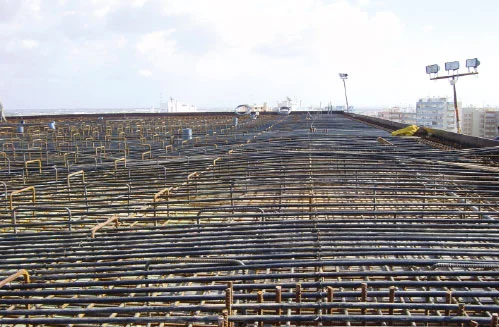
Prestress application on site is carried out in harmony with the other activities of the construction process, presenting no obstacle to meeting pre-established deadlines. Believing that preparation is the best way to reduce execution times, Ferca prepares detailed application drawings with tendon profiles, anchor reinforcement details and calculations of losses and elongations.
On site, Ferca personnel follow the company's Procedures, Quality and Safety Manual to ensure registration of operations, traceability of materials applied at each stage and verification of geometry and elongations.
Downloads
Contacts
Write to us. Present us a challenge.
Message sent successfully. Thank you!